A medical spa can have a strong service menu, experienced providers, and a promising market, and still struggle if the numbers behind the business don't work.
Before signing a lease, purchasing equipment, hiring staff, or investing heavily in marketing, prospective med spa owners need to understand what the business will cost to launch, how much revenue it needs to generate, and how long it may take to become profitable. A medical spa business plan brings those assumptions together in one document.
A good business plan is more than something to hand a lender or potential investor. It gives the owner a framework for making decisions about services, staffing, pricing, equipment, marketing, and growth.
For providers considering opening a medical spa, the business plan should answer a straightforward question:
Can this business generate enough predictable revenue to support its operating costs and deliver a reasonable return on the investment?
Why a Medical Spa Needs a Business Plan
Medical spas sit at the intersection of healthcare, aesthetics, and consumer services. That creates a business model with expenses and revenue considerations that aren't always found in a traditional medical practice.
A med spa may need to account for:
- Medical and aesthetic equipment
- Treatment rooms and facility costs
- Clinical and administrative staff
- Medical supplies
- Product and retail inventory
- Professional services
- Insurance
- Software and technology
- Marketing and customer acquisition
- Ongoing education and training
- Regulatory and compliance costs
Revenue can also come from several sources, including injectables, laser treatments, skin care, body treatments, wellness services, memberships, packages, and retail products.
That variety can create opportunity, but it also makes financial planning more important.
A business plan forces prospective owners to put actual assumptions behind the concept instead of relying on optimistic estimates.
What Should Be Included in a Medical Spa Business Plan?
There is no single required format for every med spa business plan. However, a useful plan generally includes:
- Executive summary
- Business description
- Market and competitive analysis
- Target customer
- Service menu
- Pricing strategy
- Marketing and patient acquisition plan
- Operations and staffing
- Technology and practice management
- Startup costs
- Revenue projections
- Operating expense projections
- Break-even analysis
- Cash flow projections
- Funding requirements
- Growth strategy
The level of detail should match the purpose of the plan.
If you're using the plan to secure financing, lenders may want detailed financial projections and information about the owners. If you're using it primarily as an internal roadmap, the emphasis may be on assumptions, milestones, and operational decisions.
1. Start With the Executive Summary
The executive summary appears first, but it's often easiest to write it last.
It should provide a concise overview of the proposed medical spa, including:
- Business name and location
- Ownership structure
- Services offered
- Target market
- Competitive positioning
- Business model
- Funding requirements
- Revenue expectations
- Long-term goals
Think of this section as the one-page explanation of the entire business.
For example, a plan might describe a physician-led medical spa serving a defined local market with injectables, laser treatments, skin rejuvenation, and membership-based wellness services.
The executive summary should make the concept understandable without requiring someone to read the remaining 20 pages.
2. Define the Medical Spa Business Model
Before projecting revenue, define exactly what the business will sell.
A medical spa business model might include a combination of:
Aesthetic Treatments
Examples could include:
- Neuromodulators
- Dermal fillers
- Laser treatments
- Skin resurfacing
- Body contouring
- Hair removal
- Other aesthetic procedures
Wellness Services
Depending on the practice model, a med spa may also offer wellness-oriented services such as weight management, nutritional services, or other programs.
Retail Products
Skincare, supplements, and other products can create an additional revenue stream.
Memberships and Packages
The business plan should identify which services will be offered at launch and which may be added later.
This is important because every service affects more than revenue. It can change staffing requirements, equipment costs, room utilization, supplies, training, and marketing.
3. Research Your Target Market
A medical spa business plan should demonstrate that there is a viable market for the services being proposed.
Start locally. Research the population surrounding the planned location, competing practices, household demographics, pricing, and the types of services already available.
Your competitive analysis might examine:
- Number of competing med spas
- Services competitors offer
- Treatment pricing
- Membership programs
- Online reviews
- Location and accessibility
- Provider credentials
- Brand positioning
- Patient experience
- Marketing presence
Don't stop at identifying competitors. Look for gaps.
Perhaps local competitors focus almost exclusively on injectables while there is demand for a broader combination of aesthetics and wellness services. Or perhaps the market is crowded with premium practices but lacks a mid-market option.
Your business plan should explain why patients would choose your practice.
4. Define Your Ideal Patient
A medical spa cannot realistically market to everyone. Define the patient or customer segments you intend to serve.
Consider factors such as:
- Age range
- Geographic area
- Treatment interests
- Spending behavior
- Wellness goals
- Aesthetic concerns
- Frequency of visits
- Price sensitivity
You may have multiple customer segments, but each should have a clear reason for choosing your practice.
This information will also influence your service menu, pricing, branding, marketing channels, and location.
5. Build the Service Menu Before Forecasting Revenue
One of the most important parts of a med spa business plan is the service menu.
Don't simply list every treatment you could potentially offer. Build a realistic launch menu around your resources and target market.
For each service, estimate:
- Price
- Treatment duration
- Provider or staff required
- Supply cost
- Equipment required
- Expected appointments per month
- Expected gross revenue
- Approximate contribution margin
For example, suppose a treatment is priced at $500 and the practice expects to perform 50 treatments per month.
That produces $25,000 in monthly gross revenue before accounting for supplies, labor, payment processing, overhead, discounts, and other expenses.
This basic exercise can reveal whether your service mix can realistically support the business.
6. Develop a Realistic Pricing Strategy
Pricing should reflect more than what competitors charge. Your pricing model should consider your actual costs and desired margins.
A basic pricing analysis can include:
Service price − direct treatment costs = contribution toward overhead and profit
Direct costs may include products used during treatment, disposable supplies, provider compensation tied to the service, and other variable expenses.
Then consider your fixed operating costs. A treatment can look highly profitable on paper while still failing to cover rent, administrative payroll, insurance, software, marketing, and other overhead if appointment volume is too low.
Pricing also needs to account for discounts, promotions, memberships, and package pricing.
7. Estimate Startup Costs
Startup costs are often underestimated because owners focus on the obvious expenses.
A medical spa startup budget may include:
Facility Costs
- Lease deposits
- Buildout
- Furniture
- Treatment rooms
- Signage
- Utilities and deposits
Equipment
Depending on the service menu, equipment can represent a substantial portion of the initial investment.
Include both purchase and financing costs when applicable.
Clinical Supplies and Inventory
Budget for initial supplies, skincare products, injectables, and other inventory required to begin serving patients.
Technology
Consider costs for:
- EHR and practice management software
- Payment processing
- Computers and devices
- Internet and communications
- Website
- Other software subscriptions
Professional and Administrative Expenses
These can include legal, accounting, insurance, licensing, credentialing, consulting, and other business expenses.
Marketing
A new med spa needs a plan for attracting its first patients. Include website development, branding, advertising, content, photography, promotions, and other planned acquisition costs.
Don't forget working capital.
A business may need several months of operating cash before revenue reaches the level projected in the plan.
8. Create a Revenue Projection
Revenue projections should be based on operational assumptions rather than a desired annual number.
A simple model might look at:
Number of appointments × average revenue per appointment = gross service revenue
But a more useful model breaks revenue down by service.
For example:
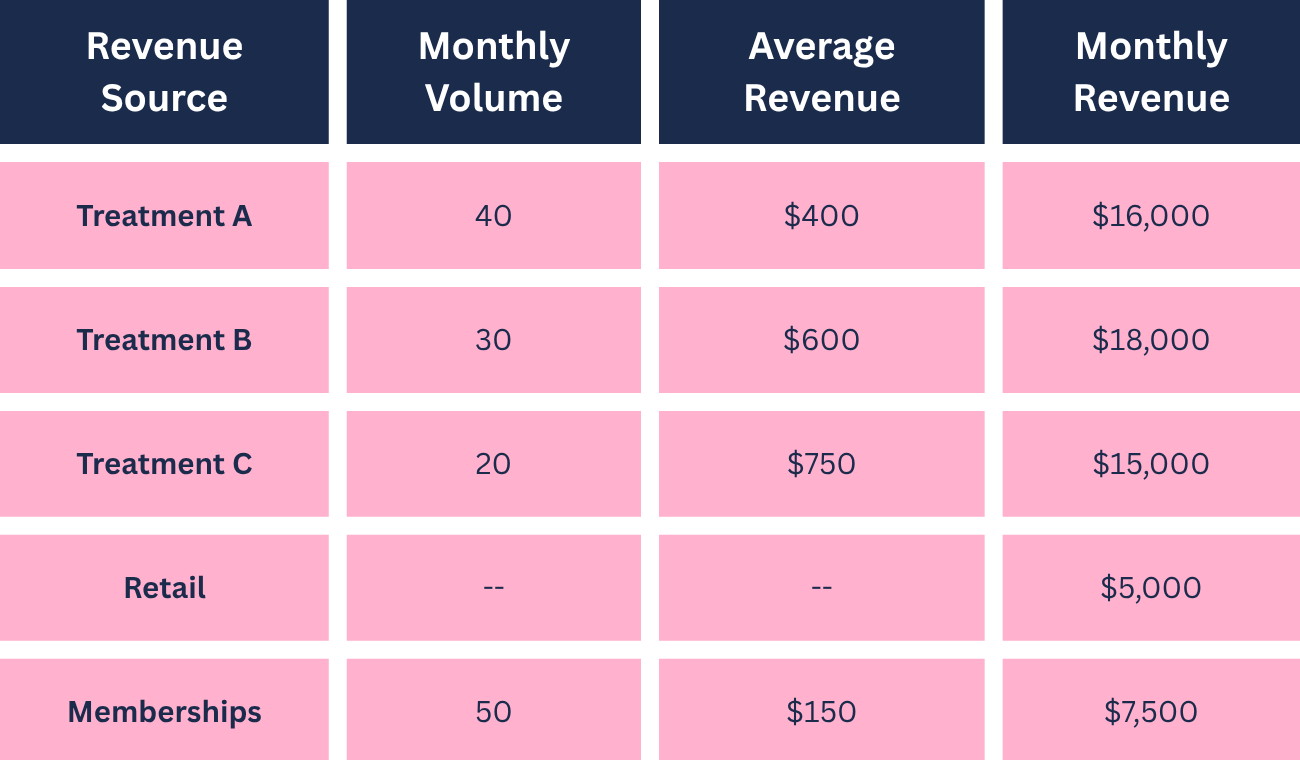
These numbers are illustrative rather than benchmarks. Your projections should use assumptions based on your local market, capacity, pricing, and expected patient demand.
Then build multiple scenarios.
Conservative Scenario
Assume slower patient acquisition, lower appointment utilization, and higher-than-expected expenses.
Base Scenario
Use the assumptions you believe are most realistic.
Growth Scenario
Model what happens if patient acquisition, retention, and provider capacity exceed your base expectations.
This is much more useful than creating one optimistic forecast.
9. Calculate Your Break-Even Point
Break-even analysis tells you how much revenue the medical spa needs to generate to cover its costs.
A simplified formula is:
Break-even revenue = Fixed costs ÷ Contribution margin
For example, if monthly fixed costs are $50,000 and the average contribution margin is 70%, the practice would need approximately $71,429 in monthly revenue to cover those costs.
The actual calculation for a med spa can be more complex because different services have different margins.
That's why it can be helpful to calculate break-even at the service level as well.
Ask:
- How many appointments are needed each month?
- How many treatment rooms are available?
- How many hours can each provider realistically see patients?
- What percentage of available appointments must be filled?
- Which services contribute the most toward fixed overhead?
Capacity matters.
If the break-even analysis requires 1,000 monthly appointments but the facility and staffing model can only accommodate 700, the business plan needs to change.
10. Plan Staffing Carefully
Labor can become one of a med spa's largest ongoing expenses.
Your business plan should outline who is needed at launch and how staffing will change as patient volume grows.
Potential roles may include:
- Medical providers
- Nurses or aesthetic providers
- Estheticians
- Front-desk staff
- Practice managers
- Billing staff
- Marketing personnel
Avoid assuming that hiring more staff automatically creates more revenue.
The better question is whether patient demand supports the additional capacity.
A practice might start with a lean team and add staff when appointment volume reaches specific thresholds. Including those hiring triggers in the business plan makes the staffing strategy more practical.
11. Build a Marketing and Patient Acquisition Plan
A business plan should explain how patients will find the medical spa.
Potential channels include:
- Local search
- Organic website traffic
- Social media
- Paid advertising
- Email marketing
- Referral programs
- Existing patient referrals
- Community partnerships
- Events
But don't treat marketing as simply a list of channels. Estimate the economics.
If the practice spends $10,000 on marketing, how many new patients does it need to generate for that investment to make sense?
Patient acquisition is only half of the equation. Retention matters just as much.
A patient who returns for treatments, joins a membership, purchases skincare, or refers another patient can have significantly more lifetime value than a one-time customer.
Your business plan should account for both acquisition and retention.
12. Include a Technology and Practice Management Plan
Technology should be part of the business plan from the beginning rather than an afterthought.
A growing medical spa may need systems for:
- Scheduling
- Patient records
- Documentation
- Digital intake
- Patient communication
- Payments
- Memberships
- Packages
- Inventory
- Billing
- Financial reporting
The goal is not to purchase every available technology product.
It is to create an operational system that can support the patient experience and the financial model outlined in the plan.
For example, if memberships are a major part of projected revenue, your practice management system should be able to support the associated billing workflow.
13. Make Your Financial Projections More Useful
A medical spa business plan should generally include financial projections for at least the first few years, with the first year broken down monthly when possible.
Consider including:
- Revenue
- Cost of goods sold
- Payroll
- Rent
- Marketing
- Insurance
- Technology
- Professional services
- Other operating expenses
- Operating profit or loss
- Cash flow
- Capital expenditures
Cash flow deserves particular attention.
A profitable business on paper can still encounter cash-flow problems if expenses must be paid before expected revenue is collected.
This is particularly relevant when investing heavily in equipment or carrying significant product inventory.
14. Identify Funding Requirements
Once your startup and operating projections are complete, you can determine how much capital the business actually needs.
Funding may come from:
- Personal capital
- Business loans
- Investors
- Business partners
- Equipment financing
- Other financing arrangements
If you're presenting the plan to a lender or investor, clearly explain how the funds will be used.
For example:
- $X for buildout
- $X for equipment
- $X for initial inventory
- $X for technology
- $X for marketing
- $X for working capital
Specificity makes the request easier to evaluate.
A Simple Medical Spa Business Plan Template
If you're building your first plan, use the following structure as a starting point:
Executive Summary
- Business concept
- Ownership
- Location
- Target market
- Services
- Funding requirements
Market Analysis
- Local market
- Target customers
- Competitors
- Market opportunity
Service & Pricing Strategy
- Initial services
- Pricing
- Packages
- Memberships
- Retail
Operations
- Facility
- Staffing
- Hours
- Technology
- Patient workflow
Marketing
- Brand positioning
- Acquisition channels
- Referral strategy
- Retention strategy
Financial Plan
- Startup costs
- Monthly operating expenses
- Revenue projections
- Break-even analysis
- Cash-flow projections
- Funding requirements
Growth Plan
- New services
- Additional providers
- Additional locations
- Membership growth
- Revenue milestones
Practical Takeaways Before You Open
Writing a medical spa business plan isn't about predicting the future perfectly. It's about making your assumptions visible before you commit significant capital.
Before finalizing the plan, make sure you can answer:
- What services will generate most of the revenue?
- What will each service cost to deliver?
- How many appointments are needed to break even?
- How much working capital is required?
- What staffing level is needed at launch?
- When should additional staff be hired?
- How will new patients be acquired?
- What percentage of patients do you expect to return?
- Will memberships or packages be part of the revenue model?
- Which technology will support scheduling, billing, documentation, and payments?
- What happens if revenue is 20% below your base projection?
That last question is particularly useful.
A strong business plan doesn't only explain how the med spa succeeds. It shows how the owner will respond if growth takes longer than expected.
From Business Plan to Opening Your Medical Spa
Once your medical spa business plan is in place, the right technology can help turn your strategy into efficient day-to-day workflows. OptiMantra provides EHR and practice management tools to help medical spas manage key operational and financial processes in one system.
With OptiMantra, medical spas can:
- Manage memberships and packages with recurring memberships and prepaid service packages.
- Schedule appointments and manage patient workflows with online scheduling and organized patient information.
- Handle payments and billing for cash-pay, hybrid, and insurance-based practice models.
- Manage inventory with inventory and supplement management, including lot and device serial tracking where applicable.
- Customize clinical documentation with chart templates that can be tailored to the practice's services and workflows.
- Support patient communications through tools such as the patient portal and appointment reminders.
For medical spas building a new practice or improving an existing operation, OptiMantra can help connect essential practice workflows within one platform. Explore an OptiMantra demo or free trial to see how it can support your business model.